Assembly of fuel cells
- Planning, design and realization of automated assembly systems for fuel cells and fuel cell stacks

The EBZ Group is one of the top suppliers in the automotive industry, specializing in toolmaking and plant construction. With our many years of experience in these areas, we are now concentrating our competencies in a targeted manner in the area of hydrogen technology.
In addition to planning, designing, and realizing production plants for fuel cells, we develop and produce state-of-the-art pressurized alkaline electrolyzers.

The continuous expansion of renewable energies sees a rise in the need for efficient energy storage technologies, as wind and solar energy are not continually available. Hydrogen can convert surplus electrical energy into chemical energy which can be stored in large quantities and utilized flexibly at a later stage.
In addition to being a versatile energy source, hydrogen is also an essential raw material in different areas of industry:
Thanks to its versatility, hydrogen occupies a central role in the energy transition, helping to replace fossil energy sources in the long term.
The majority of hydrogen produced globally is currently not created through electrolysis, but obtained from fossil energy sources. The main processes employed for this process are steam reforming and coal gasification.
Although electrolysis is currently only responsible for a small part of global hydrogen production, it is regarded as the most sustainable method. Water is split into its hydrogen and oxygen components with the aid of electric current. If electricity from renewable energy sources is used for this process, completely climate-neutral hydrogen can be produced. While hydrogen from fossil sources is designated as “gray” or “brown”, production using renewable energies produces “green” hydrogen.
Aside from the option for CO₂-free production of hydrogen, electrolysis has the advantage of allowing production to be flexibly adapted to suit the availability of renewable energies such as wind and solar. A further decisive factor is the high purity of the hydrogen produced through electrolysis. In contrast to coal gasification and steam reformation, electrolysis does not produce any catalyst poisons such as CO, SO or SOX. These substances can be removed through purification of the hydrogen, but this involves a considerable effort when compared to the necessary cleaning associated with electrolysis.
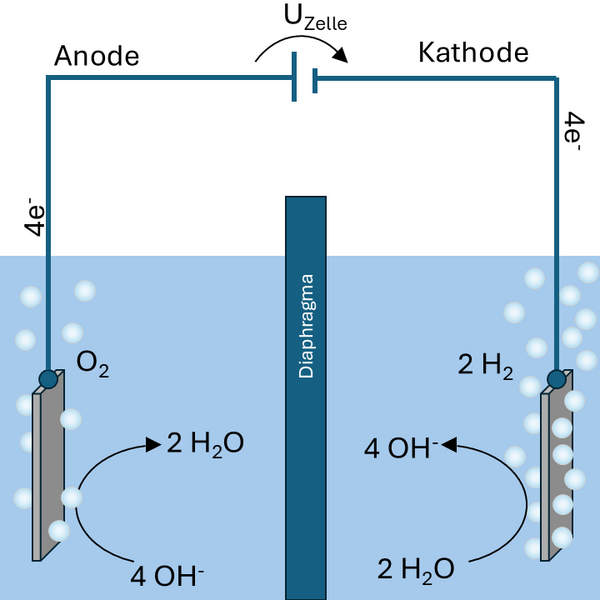
Different electrolysis technologies exist, and these differ in terms of their technical structure and degree of maturity. Each of these methods are employed in specific applications and exhibit development potential.
Alkaline electrolysis (AEL) is the longest established technology and has been used in industry for decades. It is generally based on potassium hydroxide (KOH) as an electrolyte, and hydroxide ions are transported between the anode and cathode. In contrast to other electrolysis technologies, AEL can usually be employed without precious metal catalysators. Nickel-based materials are frequently used as electrode materials, considerably reducing costs. The separation of hydrogen and oxygen occurs via a diaphragm.
AEL is particularly suitable for industrial applications, thanks to its longevity, scalability, and low material costs.
Hydrogen production occurs under pressure in a modern variant of AEL. The electrolysis process under pressure is particularly convincing in relation to renewable energies, thanks to its optimum suitability for dynamic, intermittent operation. The EBZ electrolyzer exploits this technological development to its advantage and produces hydrogen at a pressure level of 30 bar.
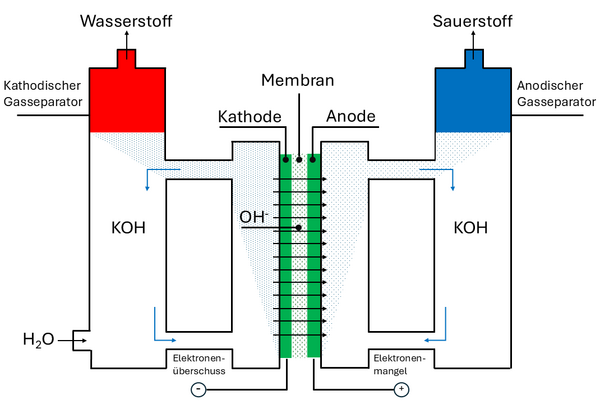
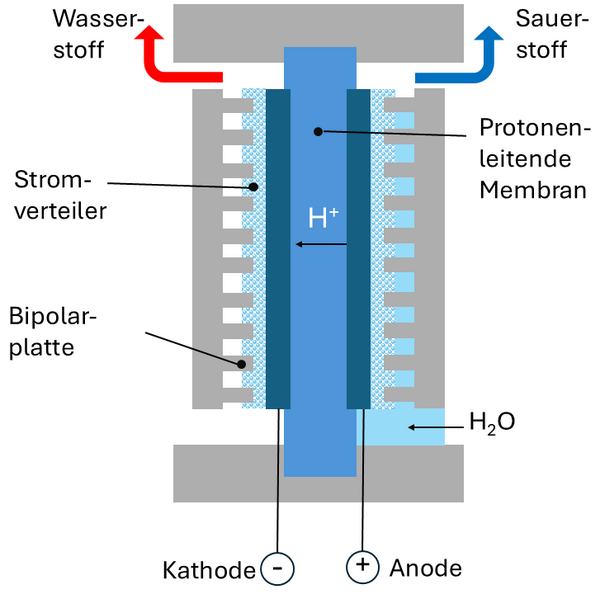
During polymer electrolyte membrane electrolysis, a solid polymer membrane (PTFE basis) is used to direct the protons and gas separation. This membrane separates the anode and cathode space and only directs protons (H⁺ ions) from the anode to the cathode.
Despite the same electrochemical reactions, the functional principle of PEM electrolysis differs considerably from alkaline electrolysis. For example, no lye is added during PEM electrolysis. The H+ ions released when producing oxygen are transported through the ion conducting membrane of the cathode where the hydrogen is created. Consequently, there is practically no water in liquid form on the cathode. Ion transportation occurs through acidic (instead of alkaline - AEL) electrolyte content. This is already integrated in the membrane.
The anode is coated with iridium, an extremely expensive and rare precious metal, and ruthenium. Platinum group metals are generally used on the cathode side. This makes the technology particularly expensive and material procurement complex.
Nevertheless, PEM electrolysis is distinguished by its compact design and flexible mode of operation.
SOEC technology (solid oxide fuel electrolysis) is based on ceramic membranes which are only conductive at high temperatures (700–900°C). The major advantage of this technology is that part of the energy required for electrolysis can be provided by thermal energy.
SOEC systems are currently still in the development phase and could be used particularly efficiently in future in industrial processes with extremely high temperatures. A certain lead time is necessary to allow the cells to reach the required operating temperature, so SOEC systems are only conditionally suitable for intermittent operation.
AEM electrolysis combines elements of AEL and PEM electrolysis. Instead of liquid electrolytes, AEM technology exploits a solid anion exchange membrane through which OH⁻ ions are transported from the cathode to the anode. The KOH concentration is considerably lower in AEL electrolysis than in AEL, slowing degradation and reducing wear.
The advantage of this technology is the possibility to use affordable materials (when compared to PEM) and, simultaneously, exploit the compact structure of PEM technology. This technology is also suitable for intermittent operation. AEM electrolysis is currently still in the development and test phase, with initial demonstration projects being conducted. Current challenges in the area of AEM electrolysis are primarily encountered with regard to the durability of exchange membranes.
A fuel cell is an electrochemical system that converts hydrogen and oxygen directly into electrical energy, heat, and water – efficiently, quietly, and free of emissions. In contrast to conventional combustion processes, this conversion does not occur through thermal reactions, but through a controlled electrochemical reaction. The basic structure of a fuel cell consists of an anode, a cathode, and a membrane positioned between these. The hydrogen fed in is split at the anode into protons and electrons by a catalyst (usually platinum). While the protons pass through the membrane to the cathode, the electrons need to pass through an external circuit, and this generates electrical current. Protons, electrons and oxygen ultimately come together on the cathode, forming pure water as a reaction product.
This core system is supplemented by other functional components. Gas diffusion layers ensure that the reaction gases are uniformly distributed and electrical conductivity is improved. Bipolar plates take on electricity distribution between individual cells in a fuel cell stack, regulate the gas flow, and aid heat dissipation. Sealing systems prevent the escape or mixing of gases, and stable and safe operation is assured through integrated cooling and supply structures.
Fuel cells can be used for diverse applications. In mobility, they enable emission-free operation of vehicles with a high range and short refueling times. In stationary applications, they supply buildings and industrial plants with electricity and heat in an efficient manner. In off-grid regions or as an emergency power supply, they also provide a reliable and self-sufficient energy supply. Fuel cells are regarded as a core technology for a sustainable energy transition, due to their extreme efficiency, environmental friendliness, and flexibility.
Our expertise in fuel cell assembly and electrolysis actively supports the market ramp-up of the hydrogen economy. Whether during development of innovative electrolyzers or in the automation of production processes, EBZ can provide you with tailored solutions for a sustainable and efficient hydrogen future.